General Motors
The Wisdom of CrowdsGeneral Motors is a recurring example of the possibilities and failures of corporate coordination. Its divisions enjoyed substantial day-to-day independence, yet the company retained centralized authority over strategy and internal organization. That combination made General Motors a defining model of the twentieth-century corporation, but its elaborate decision processes could also slow work, weaken the flow of information, and foster rivalry between departments. The book presents a more constructive side of the company as well: under Alfred Sloan, major decisions could be shaped through group management and ideas were judged by the strength of their argument, not simply by the status of their advocates.
Structure and Corporate Model
General Motors helped establish the pattern of the large twentieth-century corporation. Its divisions—including Buick, Chevrolet, and Cadillac—were run day to day much like independent businesses. This was a form of decentralization within the firm, not a transfer of ultimate authority: decisions shaping the company’s strategy and internal organization were made at headquarters, where final power rested with a small number of people and often with the chief executive.
The distinction matters to the book’s account of corporate organization. A company could delegate routine operations while preserving concentrated control over its overall direction. General Motors therefore complicates any simple contrast between centralized and decentralized firms: its divisions had operational latitude, but the corporation’s most consequential choices remained centralized.
Committees, Information, and Delay
General Motors’s decision-making machinery could turn participation into prolonged review. A relatively straightforward design question—the development of a new headlight—was considered in fifteen separate meetings, and the company’s chief executive attended the final five. The example shows how a system intended to examine decisions across management levels could accumulate layers of approval and bring senior leaders into matters that did not require their sustained attention.
The book connects such processes to a broader problem in hierarchical organizations. As proposals move through successive levels, each committee can qualify or soften what it receives. Meanwhile, responsibility becomes harder to locate: subordinates may expect supervisors to check their work, and supervisors may pass information onward rather than take responsibility for acting on it. In this account, the proliferation of review can make a corporation more formally inclusive while leaving real authority concentrated and reducing initiative lower down.
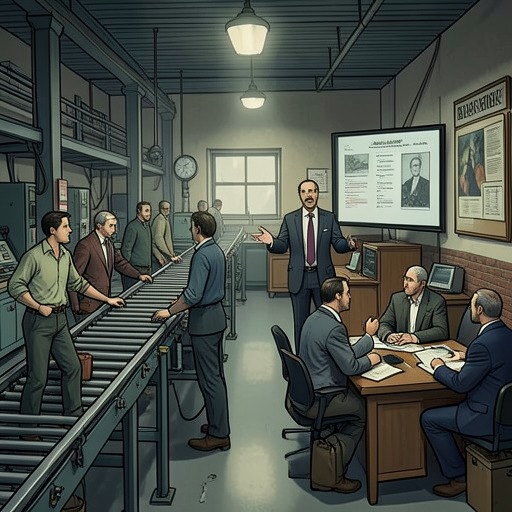
At the plant level, the cost of poor information flow could be concrete. In a General Motors plant in Van Nuys, California, two assembly-line workers repeatedly failed to install the bracket that held a car’s sunshade. If the bracket was missing, workers at the end of the line had to tear out the carpet and weld it into place. When a supervisor showed the workers the repair, one of them realized that the bracket she had been welding into place for two years held the sunshade. The episode illustrates how workers could perform a task without being told what the part did or how their work related to the finished car.
Group Management and the Case for Ideas
General Motors is not described only as a cautionary example. Alfred Sloan, the company’s chief executive, advocated a collective approach to management and made important decisions through what he called group management. His method resisted the assumption that one person’s position settled the merits of a proposal. Managers had to make a case for their ideas and expose them to informed criticism; reliance on a hunch alone was not enough.
Sloan acknowledged a limit to this approach: he had a blind spot concerning assembly-line workers. Still, his decision-making style was presented as non-autocratic. In the book’s argument, its discipline was not consensus for its own sake, but the requirement that proposals be defensible to other informed people. This could mean forgoing an occasional brilliant guess, Sloan argued, but the sacrifice was offset by the stronger results expected from ideas that survived serious scrutiny.
That model links General Motors’s internal practice to a wider principle of collective judgment. Concentrating a consequential decision in one executive leaves the company dependent on one person’s knowledge. Group management, by contrast, can draw on several people’s information and criticism. General Motors’s example therefore supports the argument that collective decision-making need not erase individual contributions: a proposal can originate with one person yet be assessed through a broader process.
Rivalry and the Limits of Decentralization
Delegating authority among divisions or departments does not automatically make a company work as a unified organization. The book contrasts General Motors’s internal rivalries with cooperation across a firm, recalling a chairman’s description of the way design and assembly staff could challenge one another over whether a proposed car body could actually be built. Design might send assembly a blueprint with a defiant challenge; assembly might respond that the metal could not be stamped or welded as specified.
The episode makes departmental competition visible as a problem of coordination, not merely a clash of personalities. When workers treat colleagues in other divisions as opponents, a company can lose the advantages that justify organizing people under one corporate structure. Internal contests over authority and resources can increase monitoring costs and interfere with cooperation, even though the competition is not the same as facing an independent firm in a market. Decentralization, the book’s broader account concludes, works only when people across the organization understand themselves to be on the same team.
Historical Significance
General Motors appears both as an industrial institution and as a test case for how organizations distribute authority. Its decentralized divisions demonstrate that local operating freedom can exist inside a centrally directed corporation. Its committees, headlight meetings, and departmental rivalries show why delegation alone is insufficient: information must travel, responsibility must be real, and separate units must cooperate rather than compete for the company’s resources.
The company’s group-management tradition provides a counterpoint to its bureaucratic tendencies. The account does not reduce effective management to either a single commanding executive or endless committee discussion. Instead, it points toward a combination of specialized judgment, candid criticism, and collective responsibility. General Motors’s history thus helps frame the book’s central organizational question: how can a large group make use of distributed knowledge without allowing hierarchy to bury it or internal divisions to fracture cooperation?